
November 16, 2026
At AVERI, our mission is to make frontier AI auditing effective and universal. Frontier AI auditing means third-party verification of leading AI developers' safety and security claims, and evaluation of their systems and practices against relevant standards, based on deep, secure access to non-public information.
The field of third-party AI assessment is developing rapidly, but key terms are often used in very different ways, which makes productive conversations difficult. Here we briefly summarize how AVERI currently defines various terms.
These definitions are intended to be clarifying and usable for most practical purposes, but are not fully precise. We do not propose them for use in, e.g., legislation, where it is appropriate to prioritize precision over everyday usability. We will update this page over time if and as our definitions change. For additional discussion, see our paper, Frontier AI Auditing.
What counts as frontier?
A frontier AI system is a general-purpose AI system that performs at least as well across a broad range of general capability benchmarks as the best systems did a year earlier. A “system” is more than just an underlying model, and includes the surrounding tools and software which make the model more capable. A frontier AI developer is an organization that has released a frontier AI system or model in the past year, or is building one that would likely qualify.
What is AI assessment?
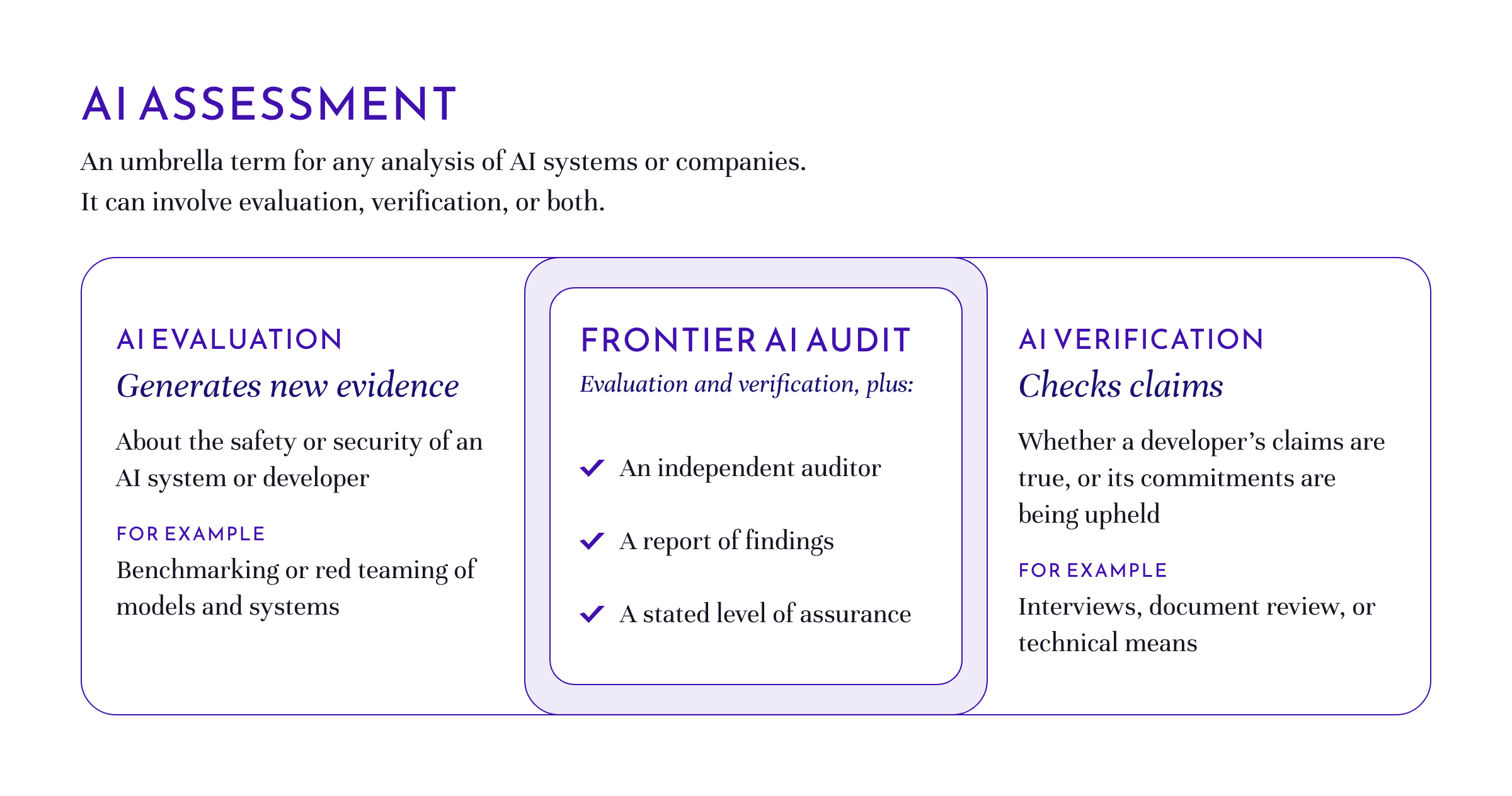
AI assessment is an umbrella term for any analysis of one or more AI systems or companies. It can involve evaluation, verification, or both, and may draw on non-public information.
AI evaluation is generating new safety or security evidence about an AI system or developer. Evaluations typically focus on models and systems and involve activities such as benchmarking or red teaming, though a company’s policies and practices can also be evaluated.
AI verification is checking whether AI developers’ claims are true, or whether commitments they have made are being upheld. This could be accomplished through, e.g., conducting interviews and reviewing documents or through technical means that can provide higher assurance against deliberate deception.
What is frontier AI auditing?
A frontier AI audit is a specific type of AI assessment involving both evaluation and verification of a frontier AI system or developer. It is carried out by an independent party, who examines an AI developer’s systems and activities, and produces a report based on this process about the safety or security of the developer’s systems and practices. The report contains the auditor’s findings and an opinion or conclusion expressing a specified level of assurance in those findings.
An illustrative test for frontier models
One illustrative way of classifying a model as frontier is if its score on Epoch AI’s Capabilities Index (ECI) is at least as high as the highest score achieved one year prior.
As of 11 November 2026, that threshold is 151.17, set by OpenAI’s GPT-5 Pro, released on 7 October 2025. Sixty-one models or systems from ten developers count – they range from the most capable closed models, such as Anthropic’s Claude Fable 5.2 and OpenAI’s GPT-6 Astra, to open-weight models such as Moonshot’s Kimi K3.1 Pro and Z.ai’s GLM-5.3.
This threshold is not perfect – Epoch publishes a confidence interval with each score, typically about two points either side, and GPT-5 Pro’s own interval runs from 149.26 to 153.17. Models within a point or two of the threshold cannot reliably be categorized – Kimi K2.6 and Claude Opus 4.5 pass, but their intervals dip below the line, while Kimi K2.7 Code and GPT-5.1 miss by less than 0.3 points.
As noted above, our aim here is to provide easily understandable definitions, and others (e.g., based on the computing power required or the amount of money spent on development) may be more appropriate in some contexts such as legislation.
The interactive chart below demonstrates this illustrative definition. You can change the date threshold using the buttons at the top, and see how this changes the models and developers classed as frontier below.
Frontier models as of 11 November 2026
Models released in the past year that score at least as high as the best model available a year earlier.
- Counts as frontier
- Below the bar
- Solid: closed or limited access
- Hollow: open weights
- No ECI score
- Threshold, with the setting model’s interval shaded
Source: Epoch AI, Epoch Capabilities Index (epoch.ai/data/eci_scores.csv), file updated 10 November 2026, retrieved 11 November 2026, used under CC BY 4.0. On 4 November 2026 Epoch moved the index to a Bayesian model, so scores differ from earlier versions. Dates are Epoch’s release dates, which can differ from first external release. Open weight labels follow Epoch’s accessibility field. Models scoring below the chart’s floor are not shown. Shaded band: the confidence interval Epoch publishes for the model that sets the bar.
