
Mission
Our mission is to make frontier AI auditing effective and universal. Frontier AI auditing means third-party verification of leading AI developers' safety and security claims, and evaluation of their systems and practices against relevant standards. This requires deep, secure access to non-public information – access that developers aren’t currently required to provide.
How We Work
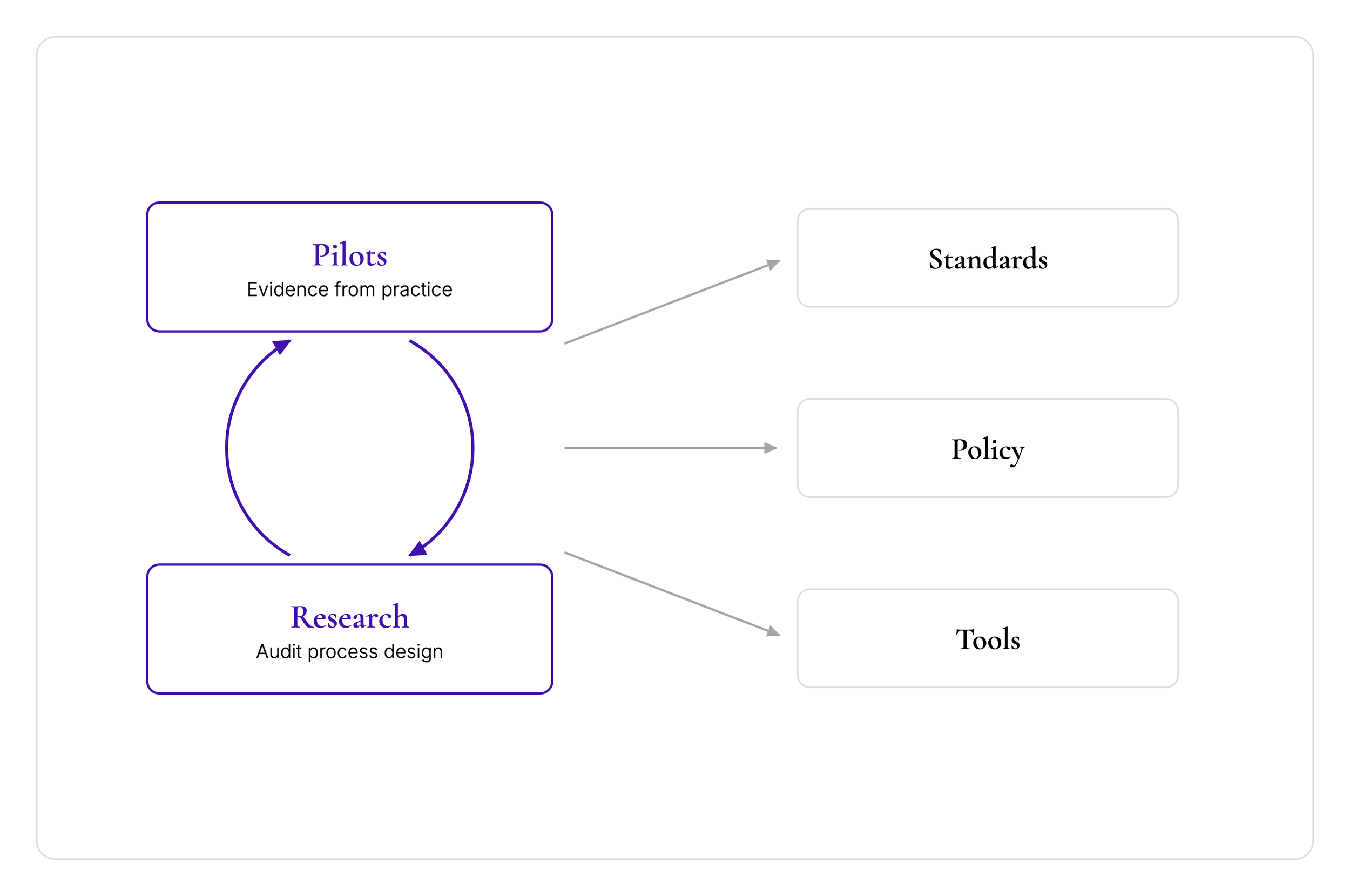
We are a standard-setter grounded in practice. We conduct pilot audits with leading AI companies and carry out technical and policy research to inform audit design. We convert insights from these processes into open source tools, industry-wide auditing standards, and policy analysis and advocacy.
Pilots & Research
Pilots
Frontier AI audits aren’t yet required. But some companies have chosen to conduct voluntary pilots with AVERI and other organizations. These pilots move the world closer to AVERI’s vision by showing what does and doesn’t work. We carry out voluntary pilot audits that help resolve open questions in audit standards and policy. For example, we are currently pursuing pilots related to verifying that companies are following their own safety and security frameworks. We recently published some initial pilot results and will share more of our initial pilot results in Q3 2026.
Research
The initial research that we published on frontier AI auditing helped to inform our initial wave of pilots. But many technical and policy questions remain open, and we are constantly seeking out new insights on the technical and policy dimensions of auditing. We want our pilots, as well as the three categories of outputs discussed below, to be informed by the latest technical insights in AI and from the hard-won expertise of audit practitioners in more mature industries.
What We Produce
Industry-wide auditing standards
We lead the development of frontier AI auditing standards, or the criteria for what counts as good audits and qualified auditors. Among our first contributions, we coauthored AEF-1–a standard defining minimum operating conditions for independent third-party evaluations – alongside other members of the AI Evaluator Forum. Our upcoming pilot findings will feed the next generation of standards.
Policy analysis and advocacy
We help design the requirements that make rigorous auditing the standard practice across the industry, working with policymakers, civil society, and industry to create a level playing field. Among our first engagements, we provided feedback on and endorsed the legislation that became SB 315 in Illinois – the first US-based frontier AI audit requirement, which takes effect in 2028. We are now providing expert input on other state and federal efforts to accelerate and strengthen audit requirements.
Open source tool development and dissemination
Every audit is different and human expertise and judgment will always be needed, but software tools and process playbooks can help make auditing much more efficient and effective. Among our first open source projects, we are developing privacy-preserving audit automation tools that help auditors analyze sensitive non-public information while safeguarding confidentiality.
Funding & Independence
Funding
No donor makes up a majority of our funding. Our funders include the AI Underwriting Company, Coefficient Giving, Craig Falls, Geoff Ralston, Good Forever Foundation, Fathom, Halcyon Futures, Sympatico Ventures, and several non-executive employees and alumni of frontier AI companies.
We've received API credits as donations or compensation from Amazon, Anthropic, Google DeepMind, Microsoft, OpenAI, and Thinking Machines Lab.
To ensure our ongoing independence, we do not accept cash donations or compensation from frontier AI companies or their executives. AVERI also discloses and carefully manages potential conflicts of interest, which you can read on our Team page.
Conflict of interest policies
Potential conflicts of interest may arise when our team members or organization have relationships or interests that could influence or appear to influence the integrity of our work. These may include: financial interests or investments in organizations we might audit or that we might advocate for others to audit; prior or ongoing consulting engagements with audited entities; or employment, advisory, familial, or personal relationships with individuals connected to audited entities.
We require all employees, board members, and contractors to disclose potential conflicts of interest to the leadership and administrative teams upon starting and biannually. When a conflict is identified, mitigation steps may include recusing personnel from projects or declining an engagement entirely. Where conflicts can be managed rather than requiring recusal, mitigation measures may include soliciting peer review from other organizations on the work in question, heightened oversight of a project involving conflicted personnel, and/or transparency statements in audit reports. We also require public disclosure of the most significant conflicts on our website.
Team-wide disclosures
Several AVERI employees have financial exposure to the AI sector as a whole as a result of owning shares in (non-AI-specific) stock indices such as the S&P 500, which includes companies like NVIDIA, Microsoft, Meta, and Alphabet. Some of these companies in turn own portions of non-publicly-traded AI companies such as OpenAI and Anthropic. Additionally, members of our team have individual investments in Microsoft, Google, NVIDIA, and Broadcom. Any ongoing, material financial conflict of interest, and any recent interpersonal conflict of interest, whether actual or perceived, is subject to mandatory recusals.
Personal disclosures
AVERI’s Executive Director, Miles Brundage, earned equity in OpenAI while employed at the company, though he has since sold all of his shares. Miles owns shares of broad-based stock indices such as the S&P 500 which themselves include frontier AI investments. Miles has personal relationships with employees at a range of frontier AI companies. Under AVERI's policies, Miles is recused from directly auditing OpenAI until two years after his October 2024 departure (though he may help facilitate an audit principally led by others, with all of his involvement documented clearly in any related public outputs).